Journal of the Indian Institute of Architects · Vol 91 · Issue 07 · July 2026 · pp. 48–52 · ISSN 0019-4913
Reproduced in full, as published

July 2026 Journal of the Indian Institute of Architects 48
Essay

From Blueprint to Frame

Notes on Architecture, Cinema, and the Spaces Between
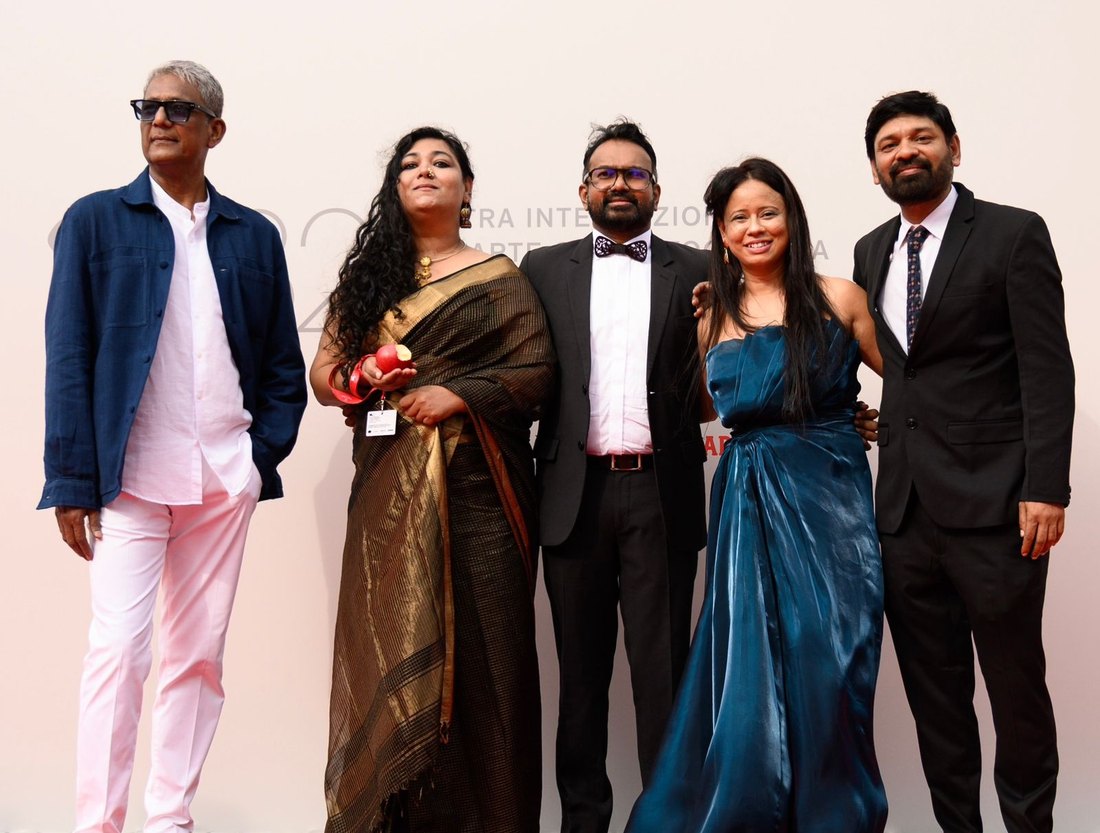
Five people standing together at the 82nd Venice International Film Festival, 2025.
Figure 1: 82nd Venice International Film Festival, 2025. Left to right: Adil Hussain, Nidhi Saxena, Vimukthi Jayasundara, Trimala Adhikari, Rahul Saxena.Source: Author

I found myself on the red carpet of the 82nd Venice International Film Festival — the world’s oldest, where cinema has been judged and celebrated since 1932 — standing beside Nidhi Saxena, Adil Hussain, Trimala Adhikari, and Vimukthi Jayasundara, filmmakers and actors of international standing, surrounded by the particular spectacle that Venice commands: the water, the light, the accumulated weight of that history pressing against the present moment. It was a world unlike anything architectural practice had prepared me for. International press. A film that had travelled farther than any drawing or building of mine ever had. And yet, standing there, I understood that I was not entirely a stranger to it. Architecture and cinema, though separated by medium and method, are joined by a common preoccupation: the shaping of space, atmosphere, and human experience. I had spent three years learning the precise nature of that connection — not in a classroom or a festival hall, but in a decaying house in the old city of Ahmedabad and in the freezing hills of Kumaon.

This is an account of what happened when the rigours of architectural practice encountered the fluid, demanding world of independent international filmmaking — and what each discipline, in the end, returned to the other.

The House in Ahmedabad

Three years before Venice, I had been standing in a very different kind of space. The house was in the old city of Ahmedabad — peeling plaster, fractured furniture, dust settling into every surface, a palpable sense of accumulated time. It would become the primary world of Sad Letters of an Imaginary Woman, written and directed by my sister Nidhi Saxena, which received the Asia Cinema Fund and premiered at the Busan International Film Festival — Asia’s most significant platform for new cinema — in 2024. I came to it not from film school or the art department, but from architecture.

By the time I arrived to work as Production Designer, Nidhi had already spent months living in relation to the house. She and the actors had inhabited its rooms, tested its silences, and allowed the house to become an active presence rather than a passive location. The work was not to impose a visual identity on the place, but to recognise the one it already possessed.

My first act was simple: I photographed everything. Not selectively, but obsessively. Every corner, every intended frame, every spatial relation the house
July 2026 Journal of the Indian Institute of Architects 49

had already established between light, surface, and the life accumulated within it. The house was dense — choked with decades of inherited furniture, discarded objects, the heavy residue of domestic life. Our task was an exercise in subtraction. We stripped the spaces back not to impose a pre-conceived aesthetic, but to allow the fundamental architecture to breathe.

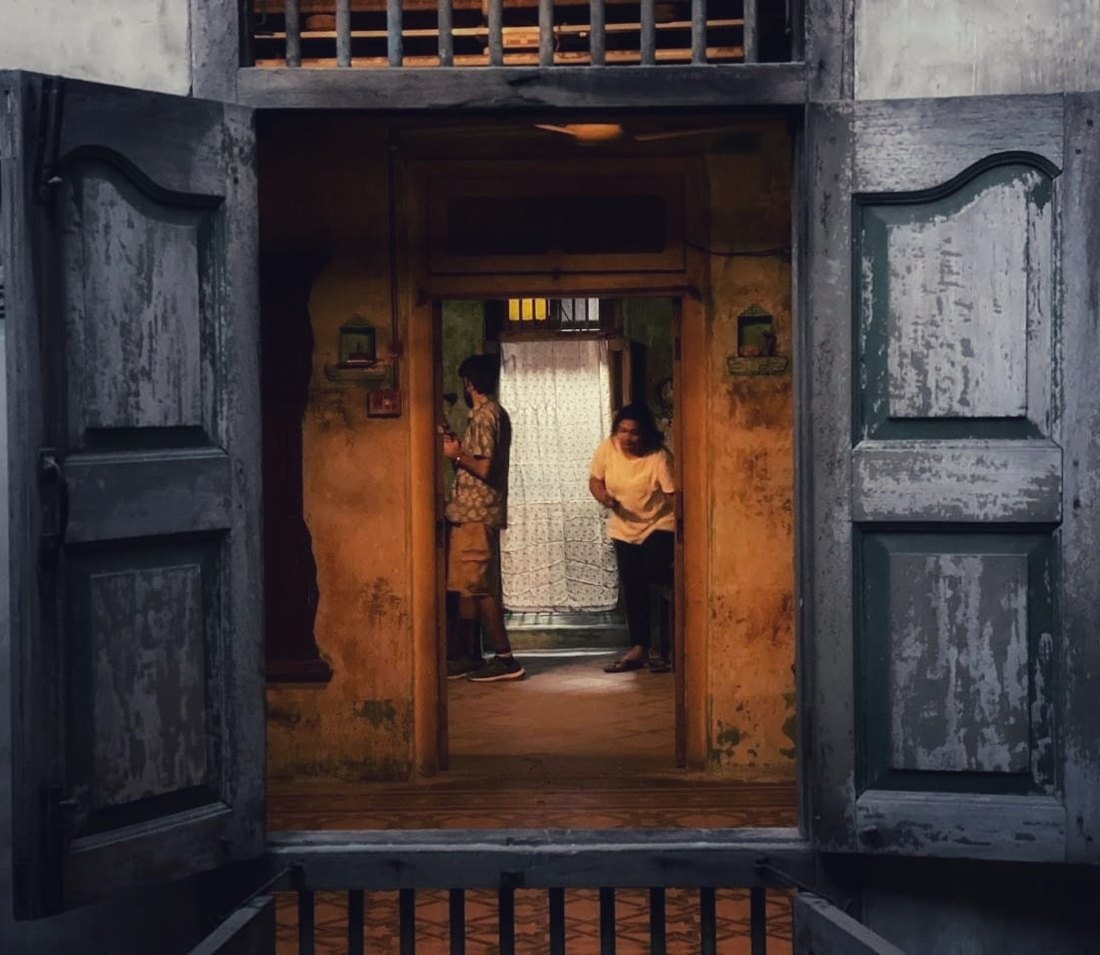
A courtyard window opening in an old house in Ahmedabad, its shutters open onto an ochre interior.
Figure 2: The courtyard window opening, Ahmedabad old city. The house that became the spatial world of Sad Letters of an Imaginary Woman.Source: Author

The inner chowk stopped me. Light came from directly above through a narrow slice of sky, the wooden balconies stacking on all sides into a vertical sequence of thresholds — a section drawing made habitable. The teal walls carried a chromatic logic — muted, worn, the colour of old lime plaster that has absorbed decades of weather and domestic rhythm. Iron-barred windows filtered afternoon light into the interiors in shifting patterns through the day, never decorative, always structural. These were not surfaces to be designed. That was the house’s own language. We had to learn it before we could work inside it — and learning it meant mostly staying out of its way.

Most of what entered the frame came from neighbouring houses in the same lane. We borrowed it, carried it by hand. Not because it looked good — because it was from that world. A staged object announces itself. We could not afford that. Everything that entered the frame had to carry its own history — not one we invented for it. Richness wasn’t the point. The only test was whether something looked like it had always been there.

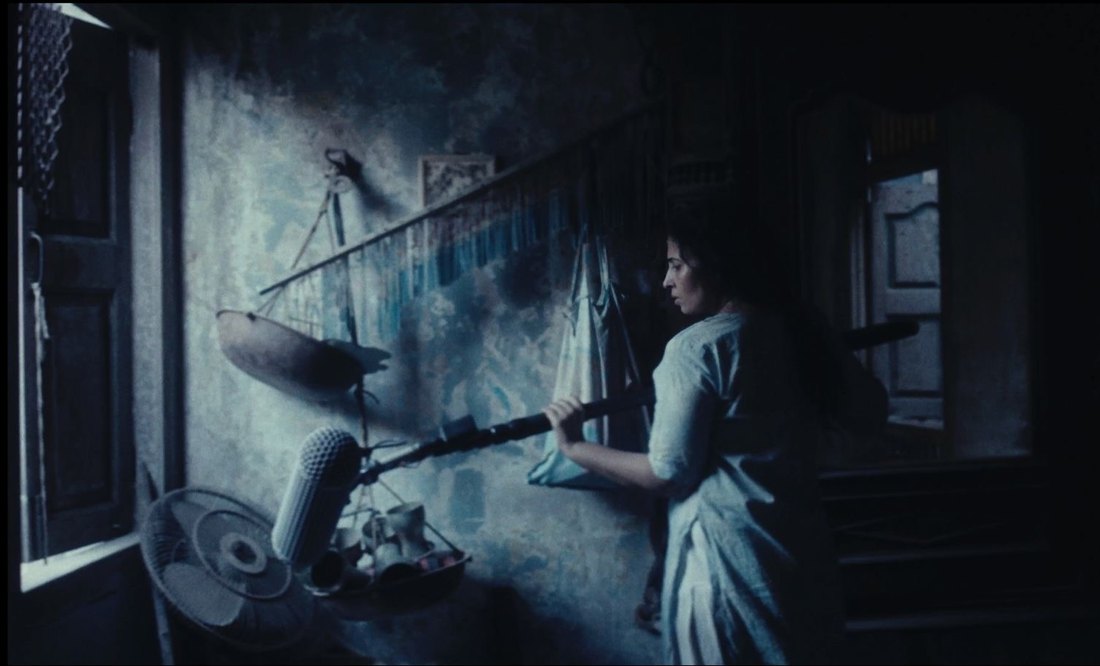
Film still: a woman holds a boom microphone against a bare plaster wall in a dim interior.
Figure 3: Film still from Sad Letters of an Imaginary Woman. The protagonist presses a boom microphone to the bare plaster.Source: Author

What stayed with me most was the density of time held in those walls. Their surfaces were not neutral backgrounds. They had absorbed weather, domestic rhythm, fatigue, and memory. There is a moment in the film where the protagonist presses a boom microphone directly to the bare plaster — listening, recording what remains inside the wall. The image needs no exposition. The house had been speaking all along. As an architect, I recognised in this a discipline I already held but had perhaps never tested so precisely: one does not begin with form, but with evidence. Space must be interpreted before it is altered. In Ahmedabad, production design was not the manufacture of appearance. It was an act of reading with unusual attentiveness.

Nidhi’s cinema is restrained: the camera holds, dialogue is spare, and emotional movement often appears through minor disturbances rather than overt action. In such a cinematic language, fabric catching wind, a plant shifting near a window, or the gradual drift of afternoon light can become dramatically charged. One of the most striking gestures in the film was the use of sari fabric as curtains — deliberate, and precise. In Nidhi’s cinema, and in the demand of this particular story, the sari curtains did not decorate the interiors. They answered a narrative need — movement in a space that was otherwise still, breath in a world that had forgotten how to exhale.

What Cinema Was Teaching Me

Nidhi and I grew up reading from the same shelves — Gorky, Tolstoy, Vinod Kumar Shukla. But we followed our curiosities differently. I moved toward architecture, technology, structure. She moved toward painting, art, and eventually cinema — not casually, but with the rigour of someone building a visual language from the ground up.

July 2026 Journal of the Indian Institute of Architects 50

Before we began production design for Sad Letters, she showed me Amit Dutta’s Nainsukh. I had not anticipated what that film would do to my thinking. Dutta constructs space the way a Pahari miniaturist constructs a procession — each figure held precisely within its architectural frame, the landscape measured not in metres but in the time it takes to move through it. The use of windows as thresholds for conversation, the scale of Pahari architecture holding a solitary figure, the yellow of mustard fields seen from horseback — watching it, I understood that architecture has pace. Not just proportion or light, but the rhythm of threshold, arrival, and delay. The time a corridor takes to release you into a room. The moment a doorway holds you before the next space declares itself.

Wong Kar-wai had already shown me what compression does to colour — how a narrow passage and a specific quality of green can make confinement feel like longing. The teal walls and warm amber interiors of the Ahmedabad house were not chosen in isolation. They had been absorbed from films before a single frame was shot. Apichatpong Weerasethakul showed me that a landscape can hold memory without explaining it — that pace, in cinema as in architecture, is not the absence of movement but its careful measure.

These were not lessons about filmmaking. They were spatial observations arriving through a different instrument than the one I had trained with.

The Mountains of Kumaon

If Sad Letters taught me about intimacy and spatial listening, Secret of a Mountain Serpent, also written and directed by Nidhi, taught me something equally demanding: that the making of cinema at an international level is also a project of coordination, endurance, and strategic management. This time my role was different. I worked as Executive Producer.

The film is set in Almora and Kausani during the shadow of the Kargil War of 1999 — a time when the men of the region were absent, leaving the women behind to navigate both reality and a local myth concerning a serpent guarding a forbidden river. The Venice Biennale College Cinema programme selected and funded the project, one of only four global projects chosen that year, accompanied by a €200,000 grant. To be selected from thousands of international applications was a recognition of considerable consequence. My responsibility was to help make the project operational.

We spent four months in Kumaon — two in pre-production, moving through Almora and Kausani on foot and by road, reading landscapes the way one reads a site before committing to a design, and then twenty-eight days of shoot before the production moved to Mumbai for post. What we were looking for was not beauty alone, but spatial truth — places whose existing character could carry the weight of the narrative without being asked to perform beyond their nature.

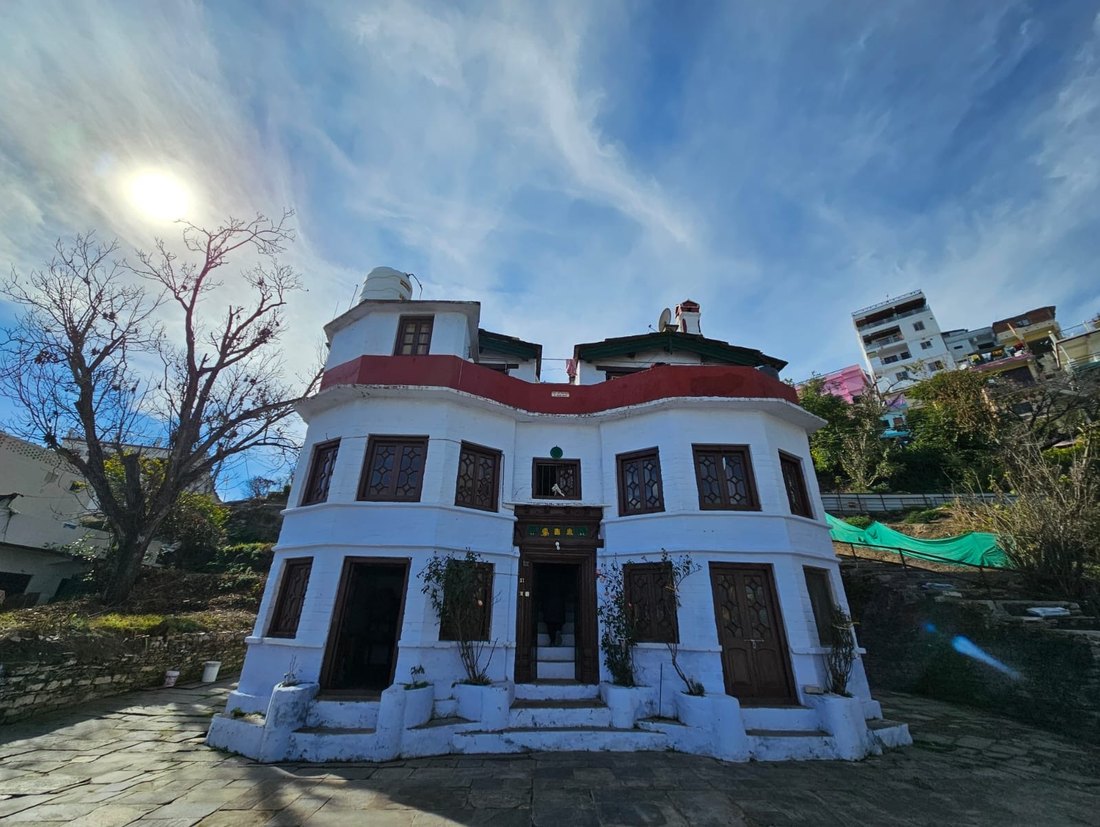
In the old Lala Bazar of Almora, we found a house more than a hundred years old — built by an army family, its architecture carrying the particular hybrid character of that history: a Kumaon vernacular absorbed into cantonment-era English influence, a central staircase rising through both floors with rooms opening on either side, the whole structure organised around a logic of occupation that had not changed in a century. Inside, a painted wooden ceiling the colour of deep water, family portraits watching from the walls, carpets laid over carpets, time accumulated in every surface and every silence. The building knew exactly what it was. We could not drill a single hole. Every intervention was negotiated, every placement considered, every piece of equipment moved with the precision that its age and dignity required. An architect arrives at a site with a programme. In Almora, this building already had one. The task was not to override it but to find, within its existing logic, the space the story needed.

A white and red hundred-year-old house with curved balconies in Lala Bazar, Almora, under a bright sky.
Figure 4: Primary location, Lala Bazar, Almora. A house more than a hundred years old, its Kumaon vernacular absorbed into cantonment-era English influence.Source: Author

Along the river, flat rocks of layered stone held the cold light of February mornings with the patience of things that have been waiting a very long time.

The twenty-eight days of shoot that followed were among the most demanding of my professional life — not despite the conditions, but because of what

July 2026 Journal of the Indian Institute of Architects 51

the conditions required. The crew numbered around fifty. Equipment had to be sourced from Mumbai, Delhi, and Chandigarh and transported into the hills. Night shoots ran twelve hours. By four in the morning the cold was serious enough that keeping the crew warm was not a support function. It was the work. We gathered one hundred goats and horses for a single bridge scene. We shot in a government school in Almora with a hundred schoolchildren who had their own ideas about the day’s schedule. Every location was borrowed, requested, or negotiated — nothing owned, nothing imposed.

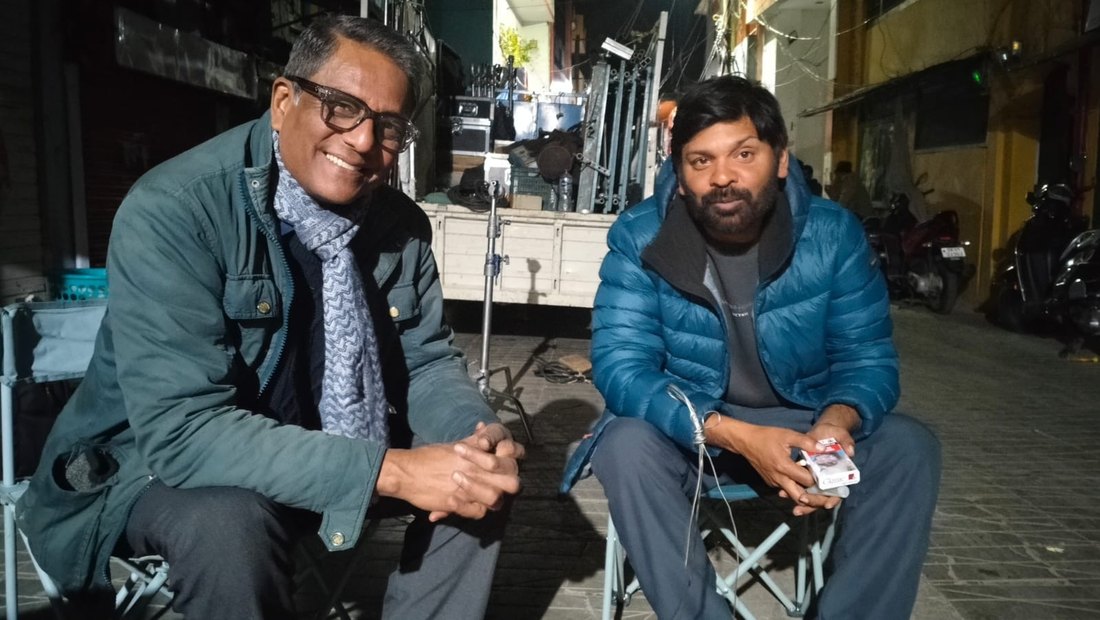
Two men seated on the Lala Bazar street in Almora at night, between shots, with film equipment behind them.
Figure 5: With Adil Hussain on the Lala Bazar street, Almora, 2 AM, between shots. A hill town bazaar is not a Mall Road — it is older, narrower, generationally inhabited; the lived-in spine of a town, layered with shops and homes above, carrying a cultural density entirely its own.Source: Author

We shot in houses whose families opened not just their doors but their lives to us. In one small mountain village, word had spread that a film was being made — and by the time the crew was ready, what felt like the entire hillside had arrived to watch. The AD called silence. The hillside disagreed. I stood there, Executive Producer of a Venice Biennale project, completely powerless before the collective curiosity of a mountain community that had decided this was the most interesting thing to happen in years. Vikas Urs called camera rolling. The murmur held its ground. Nidhi said action — and the film began anyway, as it always does, in the middle of beautiful, ungovernable chaos. No budget line prepares you for this. No production schedule has a column for it. And yet somehow, it is exactly this — the place insisting on its own presence — that ends up in the film.

What Architecture and Cinema Share

I would hesitate to claim that cinema taught me architecture anew. That would overstate the case. What it returned me to was the discipline I already practised — but with sharpened perception and a harder-won understanding of what that discipline actually requires.

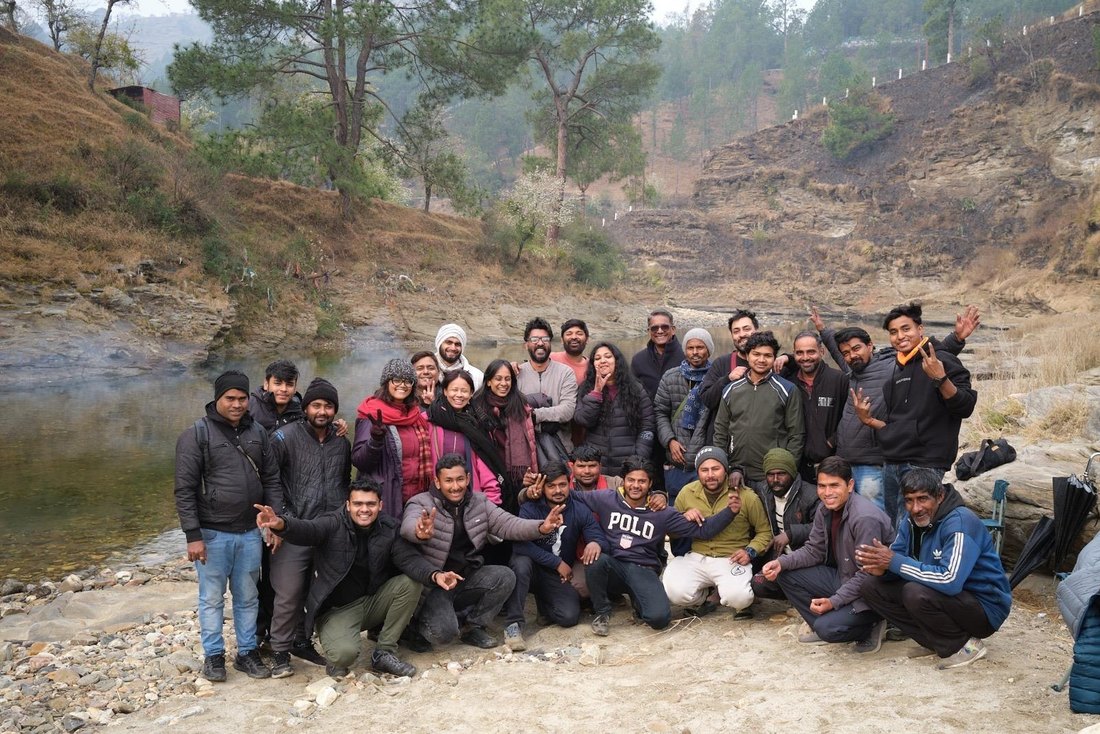
The full film crew gathered on a Kumaon riverbank after the final shot.
Figure 6: The crew of Secret of a Mountain Serpent on the Kumaon riverbank after the final shot. Twenty-eight days.Source: Author
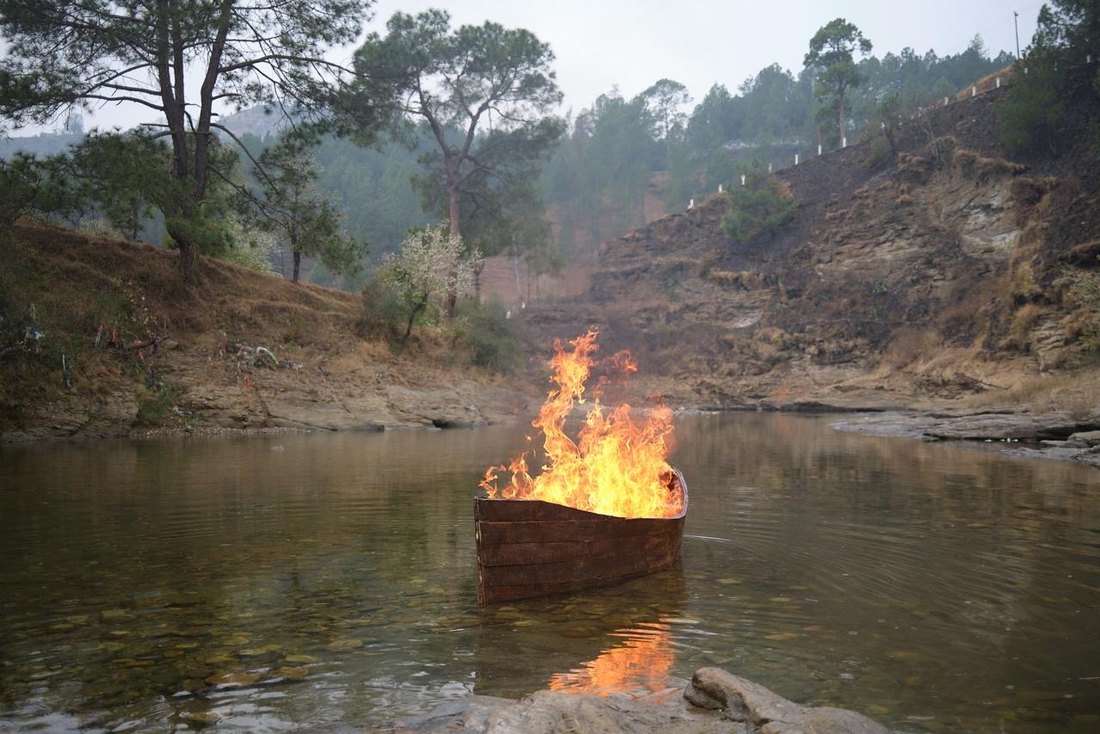
A burning boat on the Kumaon river below a bare hillside.
Figure 7: Secret of a Mountain Serpent, the Kumaon river.Source: Author

In both architecture and cinema, space is never neutral. The decaying house in Ahmedabad did more than hold its characters. It pressed in on them — setting the terms of their emotional and psychological confinement. In Kumaon, the landscape was never just a setting. It made freedom feel immense and, in the same movement, gave weight to being left behind. These are not literary metaphors laid over form. They are spatial facts. A house argues. A mountain argues. The architect’s task, like the filmmaker’s, is to listen to that argument before proposing anything in response.

Across both productions, I came to understand authorship differently. On a film set, as in an architectural studio, there is ultimately a singular vision. Every contribution must either strengthen that vision or it becomes noise. Nidhi authored these worlds entirely. I entered them in service of their coherence — first as someone who read the space and prepared it to receive a story, then as someone who built the scaffolding that allowed the story to reach the world. I had not expected that distinction

July 2026 Journal of the Indian Institute of Architects 52

— between authoring and serving — to clarify my own professional life so sharply. Architecture had always asked me to author. Cinema asked me, for the first time, to serve with complete commitment and without reservation. Both require rigour, but they require it differently.

What Cinema Returned to Architecture

I will not claim that working in cinema gave me a new methodology. But I returned to practice with two things I have not been able to set aside.

The first was that instinct about pace — which I now find everywhere in built space, once you have learned to look for it: in the sequence of rooms in a house, in the speed at which a space releases you toward something you are not yet ready for, in the moment a threshold asks something of the person crossing it before allowing passage.

The second was more personal. I had worked alongside women of considerable professional authority throughout my practice. What was different in Kumaon was not the presence of that authority — it was my proximity to the full, unmediated cost of sustaining it.

Bangkok, and Beyond

Nidhi Saxena on stage holding an award at the Bangkok International Film Festival, 2025.
Figure 8: Nidhi Saxena with the Best New Director award for Secret of a Mountain Serpent, Bangkok International Film Festival, 2025.Source: Author

The photograph from Bangkok arrived late at night. Nidhi on stage, holding the Best New Director award. I was not thinking about architecture, or cinema, or anything we had spent three years discussing. I was thinking about what it costs to build something true. Both films continue to travel. Sad Letters of an Imaginary Woman and Secret of a Mountain Serpent are still moving through festivals and screens across the world — carried by The Open Reel to audiences in cities and contexts their maker could not have fully anticipated when she was standing in a decaying house in Ahmedabad, or on a frozen riverbank in the Kumaon hills, asking a story to trust the space it was being given.

That journey has no fixed destination, which is, I have come to understand, precisely what makes it architectural.

Ar. Rahul Saxena

Ar. Rahul Saxena, IGBC AP (A22690) is Principal Architect and founder of Studio Athenos, Jaipur (est. 2007), with twenty years’ practice in healthcare and residential architecture. He was Production Designer on Sad Letters of an Imaginary Woman (Busan, 2024) and Executive Producer on Secret of a Mountain Serpent (Venice Biennale College Cinema, 2025).Email: rahul@studioathenos.in

Cover of the Journal of the Indian Institute of Architects, July 2026, Volume 91 Issue 07.

Read the essay in the July 2026 issue of the Journal of the Indian Institute of Architects

Where this was published

The essay appears on pages 48 to 52 of the July 2026 issue of the Journal of the Indian Institute of Architects, a peer-reviewed journal published under ISSN 0019-4913. The text on this page is the published text, reproduced without alteration.

Download the July 2026 issue (PDF) Complete issue · 60 pages · 4.7 MB · the essay begins on page 48
Cite this essay

Saxena, R. (2026). From Blueprint to Frame: Notes on Architecture, Cinema, and the Spaces Between. Journal of the Indian Institute of Architects, 91(07), 48–52. ISSN 0019-4913.

© 2026 Studio Athenos