The Architecture of Waiting
On waste, vigils, and what hospital plans miss about the people who gather there.
In brief
- Ordinary waste collects in the same hospital corners — paper cups, wrappers — because families made to wait there have nowhere to set down what is in their hands.
- It is not a housekeeping failure. About 85 percent of healthcare waste is ordinary general waste; the regulated biomedical stream is only about 15 percent.
- The residue marks where a plan drew “circulation” but people use it as an unnamed waiting room.
- The environment is not cosmetic — evidence-based design has shown for forty years that the building is part of the care.
No one waits alone
The family arrives at the worst hour and the best one alike — and the building rarely makes room for them.
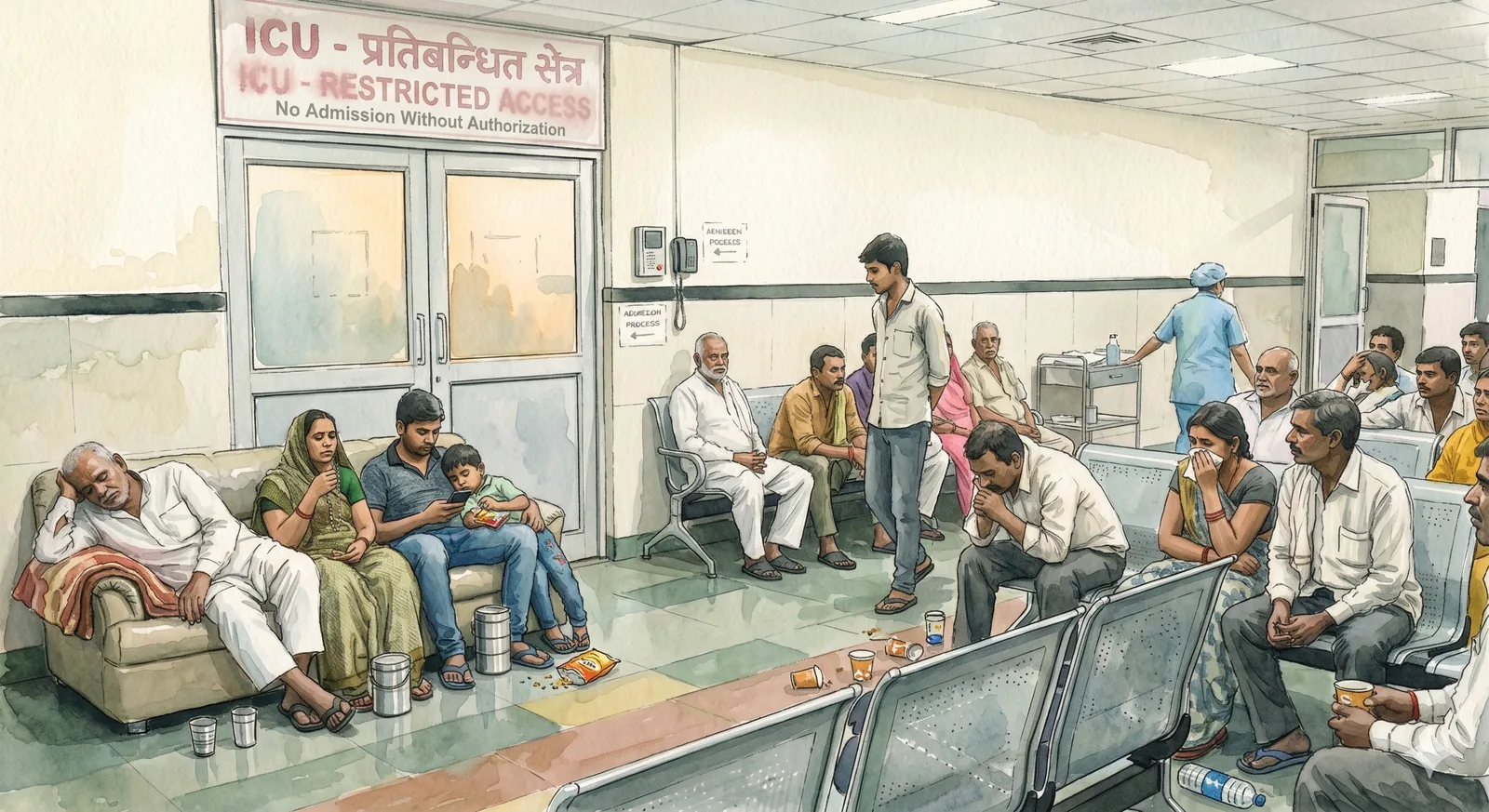
In India, no one goes to the ICU alone. When someone is admitted to critical care, the family arrives — and then keeps arriving. A brother from the next district, an uncle who drove through the night, neighbours who would not dream of staying away. They are allowed past the doors twice a day, at eleven and at five. The rest of the time they hold the corridor: a dozen people keeping a vigil that may run eight, twelve, sixteen hours, for days, because leaving the sightline of that door is unthinkable while someone they love is behind it. They drink tea. Someone passes around biscuits because no one has eaten. By evening the floor along the wall carries the quiet evidence of all of it — paper cups, a few wrappers, a folded newspaper no one finished.
One floor away, the same thing happens for the opposite reason. A child has been born, the family arrives to celebrate, and sweets and tea go round in disposable cups to everyone who came. Grief and joy both summon the crowd. Both run on chai in throwaway cups.
That collection of cups in the corner is usually read two ways: a failure of housekeeping, or a failure of manners. It is neither. It is evidence. The building is telling you something, and most plans never learn to read it.
What the floor is telling you
People are remarkably consistent about waste; the building decides where it collects.
When Walt Disney planned Disneyland, he watched visitors carry their rubbish only a short distance — a few steps, perhaps fifteen — before, if there was nowhere to put it, dropping it where they stood. His answer was not a campaign asking people to behave. He placed the bins inside that reach and designed for the behaviour instead of against it. In a hospital the distance is shorter still: a frightened family will not wander a corridor hunting for a bin, because they will not leave the door. None of this is a moral failing. It is a measurable fact about tired human beings, and it can be designed for.
Most of what a hospital discards belongs to this ordinary register. The World Health Organization estimates that around 85 percent of healthcare waste is general, non-hazardous waste — comparable to what a household produces. The regulated, colour-coded streams that command all of our attention are the other fifteen. The eighty-five is the tea cups and the wrappers: the part no one designs, and the only part the waiting family ever actually sees.
General, non-hazardous waste ~85% · regulated biomedical ~15% (WHO). The 85% is the cups and wrappers of waiting — the part no one designs, and the only part the family sees.
And the environment they see it in is not cosmetic. Roger Ulrich’s 1984 study — among the most cited in all of healthcare design — showed that patients with a view of nature recovered faster and needed less pain medication. The field that grew from it, evidence-based design, was never only about the patient; it has always concerned four people at once — the patient, the family, the physician, and the nurse. The building is part of the care.
The residue gathers a few metres from the door behind which a life is being decided. That corner outside the ICU was drawn as circulation — a place people pass through. In use, it is a waiting room with no name. The problem was never the number of bins. It is that the building asked people to stop there and never acknowledged that it had.
The error is older than the litter. It is in the drawing.
Designed around care, as a method
Designing around care is a method, not a sentiment.
When we plan a high-acuity floor, before a single finish is chosen, we map where families will gather and be told to wait — and what will be in their hands when they do. A threshold that stays clean for the clinician can still fail as a care environment if it forces a family into a waiting it cannot keep with dignity. Care is not only the patient on the bed. It is the patient, the family who waits, the nurse who walks it, the doctor who works it, and the building that must last.
So walk your own building tonight, after the visitors have gone, and look at the floor. You will find the same corners collecting the same quiet evidence — outside the ICU, at the foot of the lifts, along the wall where people are told to wait. Those corners are not a cleaning problem. They are rooms your building made without meaning to: the places it asked people to stay, and gave them nothing.
Read it only as litter, and you miss what it is telling you — that somewhere, the plan made room for the patient and forgot the people who came with them. A hospital that can read its own waste knows who actually lives in its walls.
Read more about our hospital architecture services and how we approach designing a hospital from brief to accreditation.
Ar. Rahul Saxena, IGBC AP
Founding Editor · Studio Athenos, Jaipur
This article is part of Healthcare Design Dialogs, edited by Ar. Rahul Saxena, IGBC AP.