Balaji Cure & Care Hospital, Jaipur — designing a NABH-compliant multi-speciality hospital
NABH-accredited multi-speciality hospital · Sirsi Road, Jaipur · Studio Athenos
In brief
- Balaji's existing Sirsi Road facility had outgrown 500–700 patients a day. The new building serves 1,000–1,200 daily across full specialities, for ₹21 crore all-in, excluding beds and equipment.
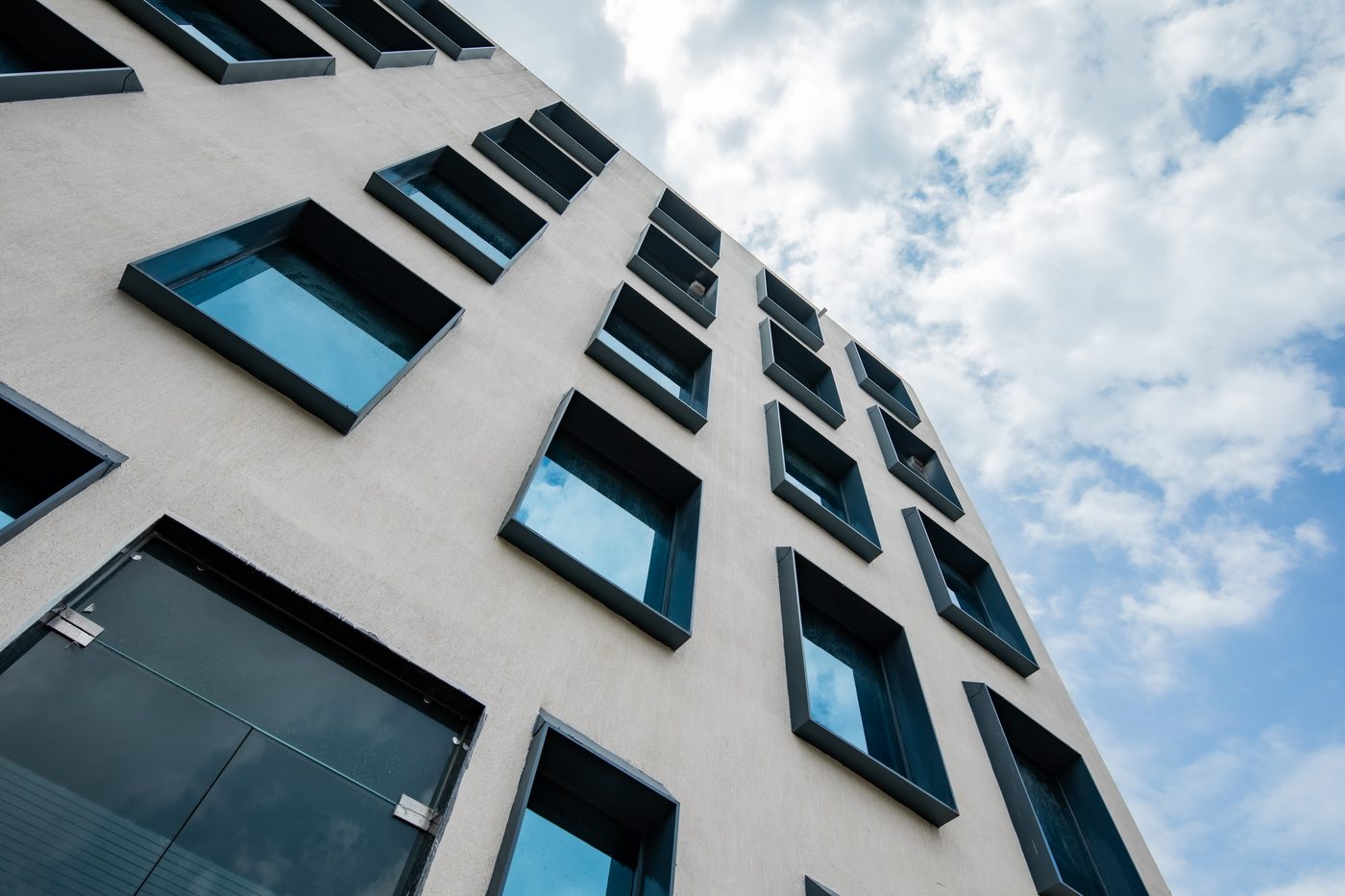
- The site is a 1,488 m² plot bordered by roads on three sides. The envelope is engineered against heat and highway noise — Low-E double-glazed units in mild-steel frames extruded 10 inches for shade and rhythm.
- Vertical zoning is the infection-control instrument: diagnostics on the lower ground, OPD and emergency on the ground, critical care and cath lab above, five operating theatres and the ICU on the surgical floor.
- Every NABH requirement was resolved in the plan, not patched during construction — and the hospital received NABH accreditation.
The brief
Balaji Cure & Care Hospital had been running at Sirsi Road for years. The existing facility was handling 500 to 700 patients a day, and the demand had outgrown it. The client needed a new building — same site, same community, but designed to serve 1,000 to 1,200 people daily across a full range of specialties, within a budget that would keep care accessible to the suburban and rural families who depend on this hospital.
The catchment is specific: a 100-kilometre radius pulling in families from Jobner, Renwal, and the towns and villages along the Sirsi Road corridor. Predominantly middle and lower-middle-class households. Affordable care was not a tagline — it was a design constraint that ran through every decision, from material selection to structural system. Total project cost: ₹21 crore, all-in, excluding hospital beds and medical equipment.
The project was submitted to the PHDCCI C4R2 Healthcare Space Design Competition.
The site
The plot is 1,488 square metres, bordered by roads on three sides. The 160-foot highway to the north is the primary access — and the primary problem. Heavy traffic, continuous noise, and significant heat ingress from the north face. The 30-foot roads to the east and west offer secondary access but limited setback.
Unlike greenfield hospital sites in satellite towns, urban plots in Jaipur rarely exceed 1,500 square metres. Most hospitals on constrained sites respond by restricting floor counts or reducing OT capacity. Balaji’s brief required the opposite — a 1,488 sq m plot serving 1,000 to 1,200 patients daily, with a full OT complex, critical care units, and NABH-compliant zoning across six floors.
A three-road site sounds like an advantage. In a hospital, it means three directions of acoustic and thermal exposure, three entry points to manage, and a building envelope that must work harder than usual. The response was not to close the building down but to engineer the envelope. Every window uses Low-E Double Glazed Units in mild steel frames — addressing heat ingress and acoustic disturbance simultaneously. The MS frames are extruded 10 inches from the wall face, creating shading, breaking the flatness of the elevation, and giving the building a rhythm that reads from the road. It is a deliberate departure from the glass-and-ACP aesthetic that has become the default for hospitals in this region.
The floor plan is a medical decision
In hospital architecture, zoning decisions directly affect infection control, staff efficiency, and NABH compliance. On a constrained urban plot, every floor has a clinical logic, not just a programme list.
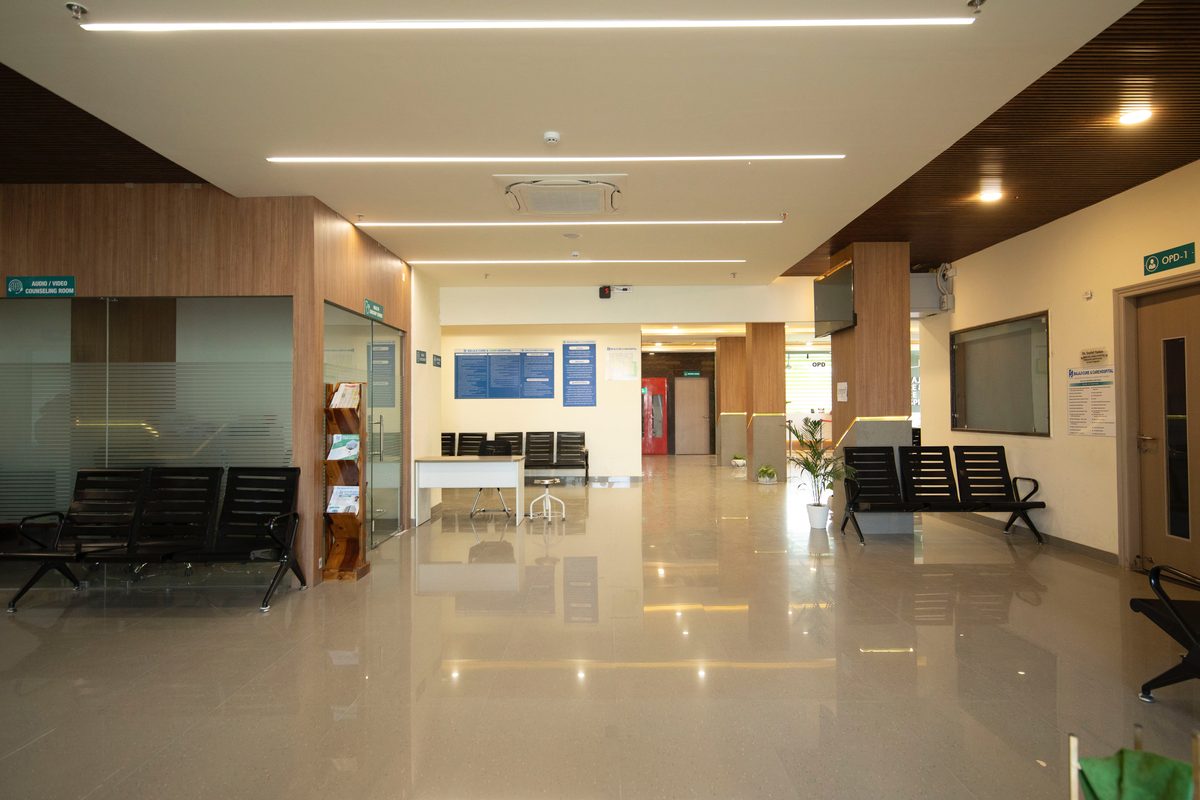
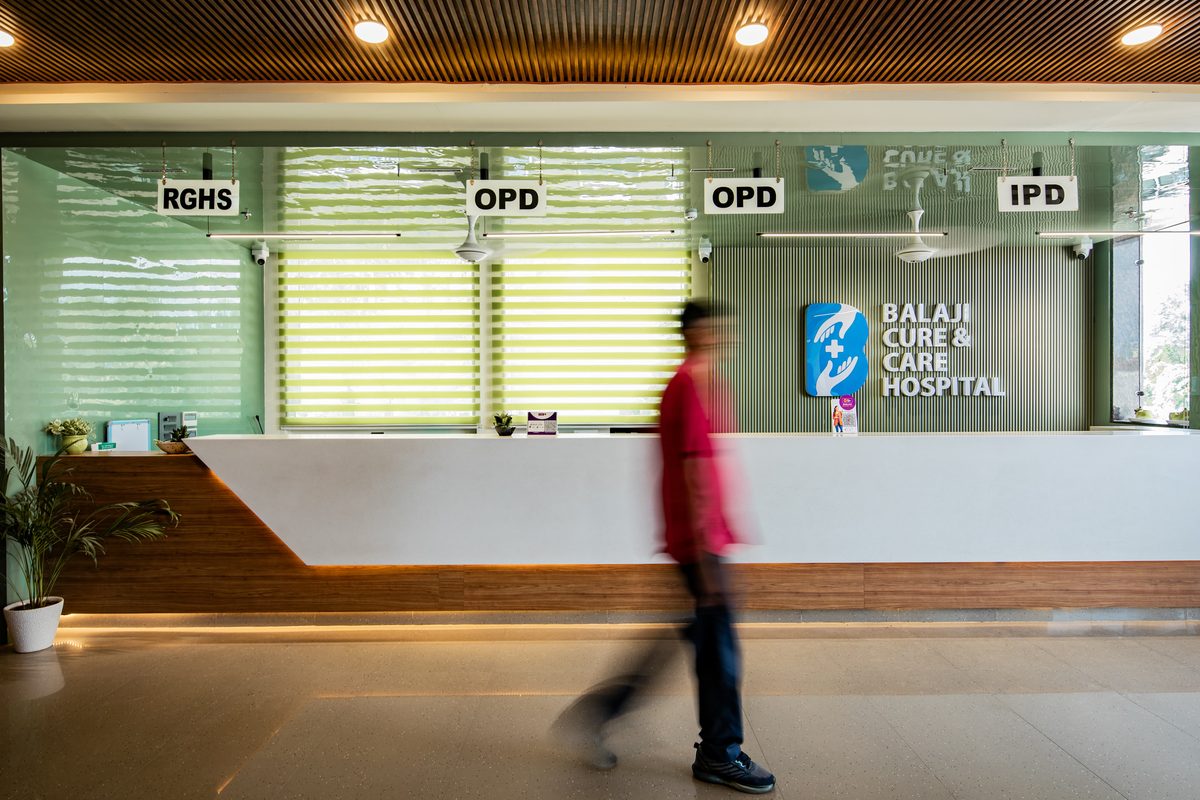
The ground floor handles high-footfall clinical areas: Emergency Department, OPDs, Reception, and Pharmacy — designed to process 700 to 800 patient visits per day. The lower ground floor handles diagnostics: Radiology, CT, USG, Pathology Lab, with its own billing counters and separate entry from the driveway ramp. Patients reach imaging without passing through the main lobby.
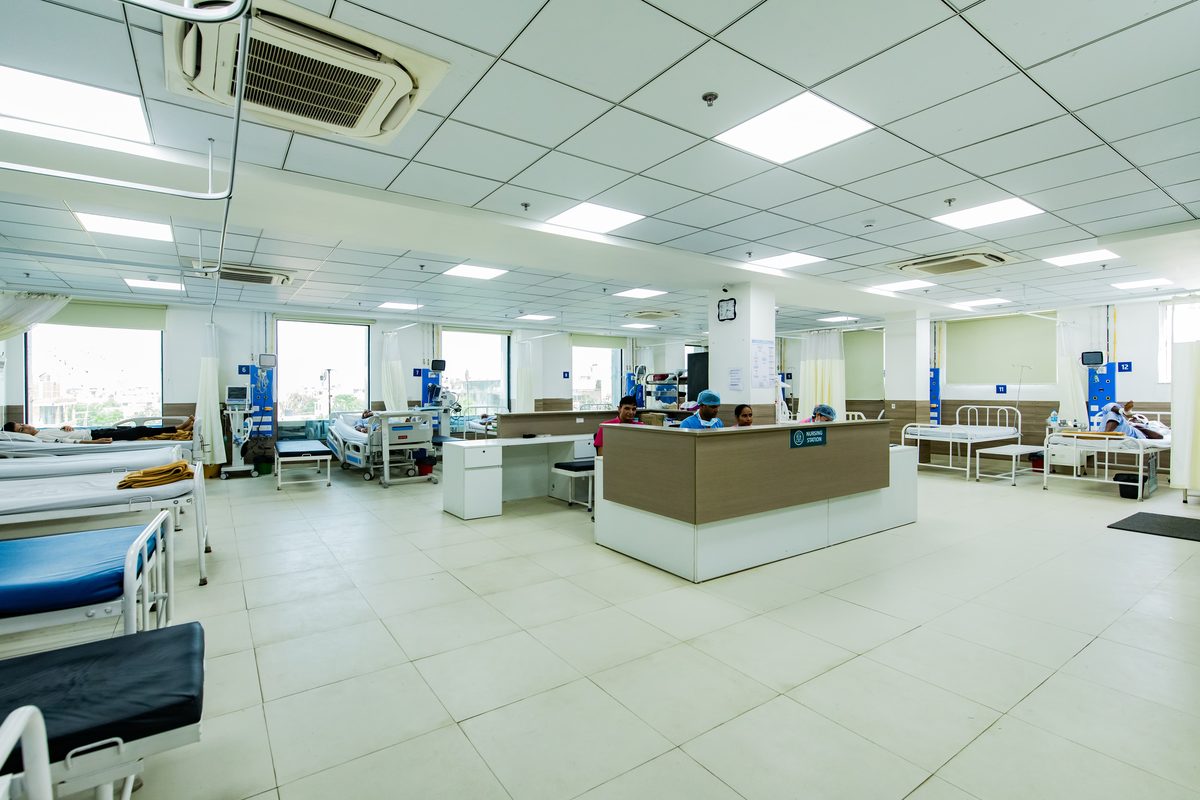
The first floor separates women’s health — three dedicated OPDs, a labour room, paediatric ward, nursing station, and a Cardiology OPD placed at the front with natural light and a buffer from general traffic. The second floor holds the Cath Lab, CCU, and NICU. The third floor is the surgical floor: five operation theatres connected by a sterile corridor, with the ICU adjacent. The fourth floor is private rooms.
This vertical zoning enforces infection control by design. The surgical floor — OTs and ICU — receives 75 to 100 daily visits. The ground floor receives 800 or more. This separation is achieved through floor-level segregation, not signage — a design principle that directly meets NABH infection prevention standards.
Every floor in a hospital has a clinical logic. If that logic is wrong, no amount of finish specification or interior design will correct it.
NABH compliance — what the drawings deliver
NABH accreditation is earned by the hospital’s operations, but the architecture either enables it or fights it. At Balaji, every compliance requirement was resolved in the plan, not patched in during construction.
NABH requirements addressed in this project:
- Segregated patient, staff, and visitor circulation in ICU, CCU, and NICU
- Sterile corridor connecting all 5 OTs to pre-op and post-op
- Dedicated doctor duty rooms on critical care floors
- Family lounge at NICU — visual proximity, no sterile breach
- Lead-lined X-ray rooms with controlled temperature and humidity
- Minimum floor areas for each specialty per NABH standards
- Infection control finishes throughout: anti-viral laminates, non-porous tiles, Corian reception surfaces, low-VOC paints
Balaji Cure & Care Hospital received NABH accreditation. That outcome begins with the drawing.
Materials that carry clinical weight
The material palette was chosen under two pressures: NABH compliance and a ₹21 crore all-in budget.
Anti-viral laminates on columns and wall cladding. Non-porous tiles at column bases — placed specifically to prevent shoe-dust contamination at the surface. Corian on the reception counter for seamless, cleanable surfaces. Low-VOC paints throughout. A green wall in the main circulation corridor — a biophilic intervention that reduces patient and staff stress in high-traffic hospital environments. MS square frames with Low-E DGU glass on the facade — thermal insulation, solar control, noise reduction, simultaneously.
These are not premium finishes. They are infection-control decisions expressed as interior design.
The facade
The elevation of Balaji Cure & Care Hospital is built on a single repeated element: a mild steel square frame, extruded 10 inches from the wall, housing a Low-E DGU glass unit. Arranged in a grid across all floors, these frames shade the glass, reduce heat gain, dampen highway noise, and create a three-dimensional surface that changes with light through the day.
The decision to avoid curtain wall glazing and ACP cladding was deliberate. A hospital serving a rural and suburban community does not need to perform corporate. It needs to be legible, durable, and climatically responsive. The textured paint finish, WPC louvers, and the rhythm of the extruding frames give the building a presence on the 160-foot road without architectural excess.
What this means for hospitals planning a new facility
Three things this project demonstrates that apply to any hospital brief in Rajasthan:
Floor plan zoning is not layout — it is your primary infection control instrument. Where you place the OT complex relative to general circulation determines whether NABH compliance is designed in or retrofitted.
Budget decisions affect clinical outcomes. The choice between Corian and standard laminate, between Low-E DGU and ordinary glass, between anti-viral finishes and standard paint — these are not aesthetic choices. They are maintenance, infection, and accreditation decisions.
NABH planning must begin at concept stage. Hospitals that engage an architect after the structural frame is up spend money correcting what should have been right from the first drawing.
This project reflects our approach as hospital architects in Jaipur, designing NABH-compliant healthcare facilities across Rajasthan. For hospitals planned in Jaipur, Bikaner, Pilani, Merta, or elsewhere in the region, the constraints are familiar — and the approach is the same.
What the project taught us
A 1,488 square metre plot, a ₹21 crore budget, a community that needed a hospital that actually worked. Every design decision responds to clinical, operational, or environmental requirements. Nothing in this building is there because it looked good in a reference image.
That is what designing for healthcare in Rajasthan actually means. Not the vocabulary of a hospital — the discipline of one.
Ar. Rahul Saxena, IGBC AP
Founding Editor · Studio Athenos, Jaipur
This article is part of Healthcare Design Dialogs, edited by Ar. Rahul Saxena, IGBC AP.