The room that cannot be wrong — LINAC bunker design in India
A radiotherapy facility is not an extension of your hospital. It is a physics problem that must become architecture — designed in a fixed sequence, approved by a nuclear regulator, and built without a single mistake in the concrete.
In brief
- India runs a deficit of roughly 800 Linear Accelerators — fewer than 550 functional machines — so cancer patients in tier-2 and tier-3 cities travel hours for radiotherapy that should exist in their district.
- A LINAC facility inverts normal construction logic: the regulatory timeline drives the building, the physics drives the structure, and the AERB-approved drawing — not the contractor — governs what can change.
- The room is a shielded enclosure: primary barriers about 2.4 m of dense concrete, a maze entry, an 8.5-tonne machine needing 4 m clear height and a 7 × 7 m floor.
- The most damaging failure is invisible — concrete honeycombing in a barrier wall is a radiation path — and AERB reviews the whole oncology department, not just the bunker. From Jeevan Raksha Complete Cancer Care Centre, Bikaner.
India is running a deficit of roughly 800 Linear Accelerators. Against a recommended benchmark of one LINAC per million people, the country has fewer than 550 functional machines — a number that has barely moved in years, because decommissioning nearly keeps pace with new installations. Every year, hundreds of thousands of cancer patients in tier-two and tier-three cities travel for hours to access radiotherapy that should exist in their own district. The gap is well-documented. The intent to close it is real. And yet, hospital after hospital that commits to adding a LINAC facility runs into the same wall: they find out, eighteen months into the project, that the process they did not understand had already determined their outcome.
When a hospital trustee or administrator decides to add radiotherapy, the mental model is usually this: identify a room or a floor, engage a contractor, procure the machine, treat patients. It is the model that works for almost everything else in hospital construction — an OT, a new ward, a diagnostics floor. The building drives the schedule. The team adapts to the space as it comes up.
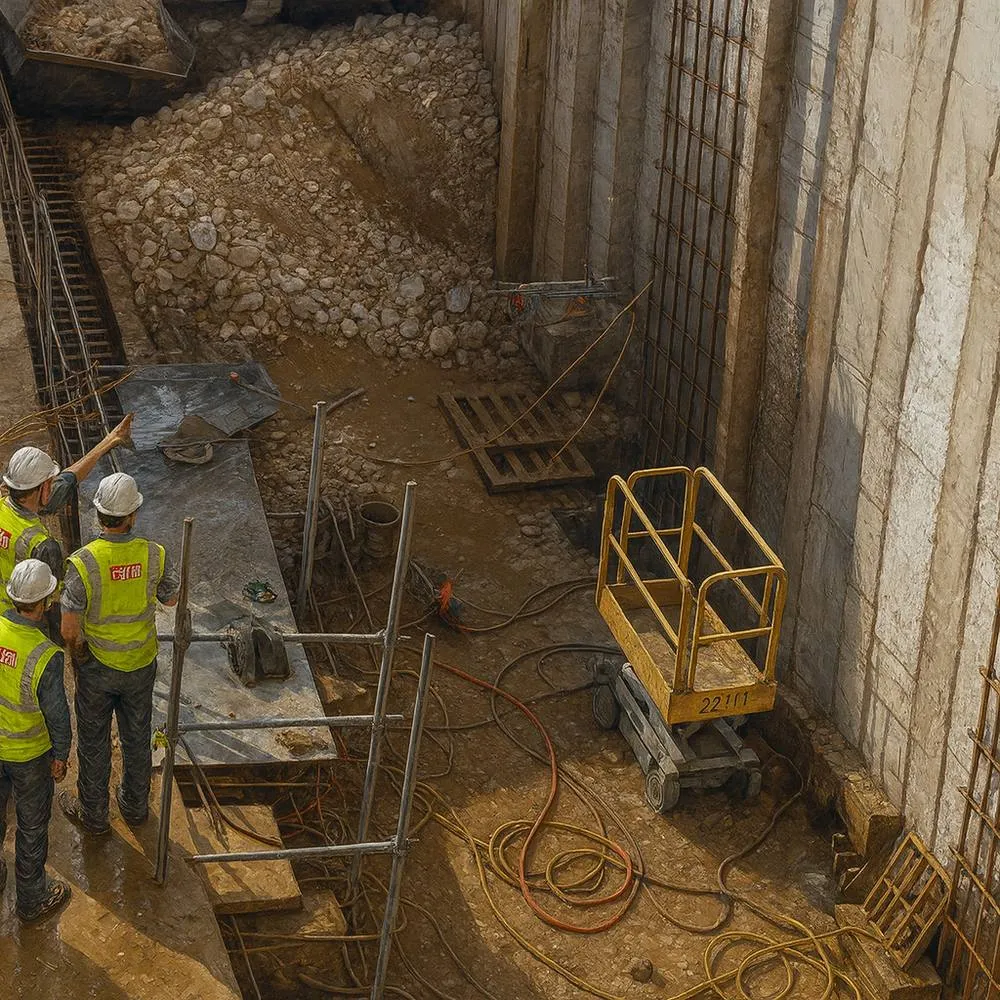
A LINAC facility inverts every part of that logic. The regulatory timeline drives the building. The physics drives the structure. The approved drawing — not the contractor, not the hospital — determines what can and cannot be changed during construction. Studio Athenos designed one such facility, at Jeevan Raksha Complete Cancer Care Centre, Bikaner — a 300-bed NABH oncology hospital with two LINAC bunkers, PET-CT and a gamma camera. It was the project that made clear what this building type actually demands.
The decisions that cannot be undone in a LINAC project are made before the architect draws the first line. Most administrators do not know this until it is too late to change them.
What you are actually building
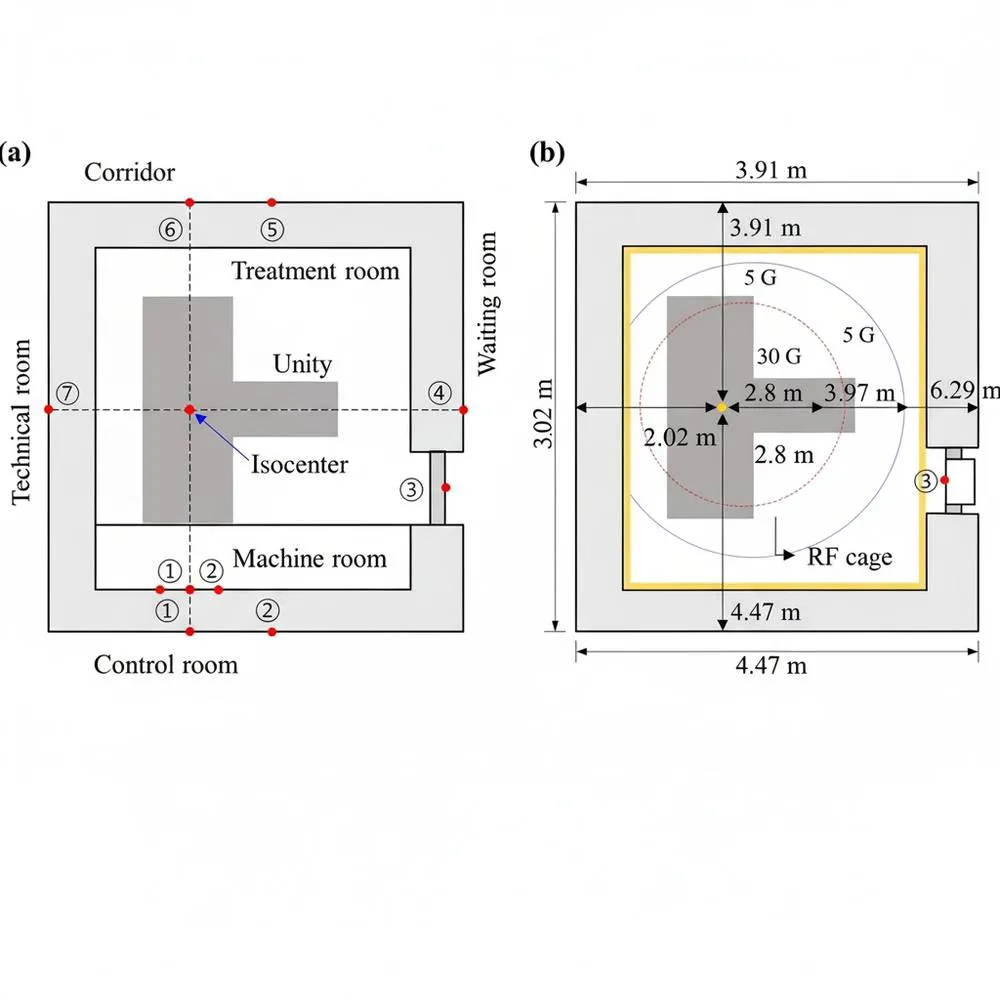
The LINAC machine fires high-energy radiation at cancer cells — beams powerful enough to penetrate ordinary construction materials and reach people on the other side of the wall. The room that houses it is not merely a room with thick walls. It is a shielded enclosure designed by a medical physicist, sized by equipment specifications, located within the hospital by radiation safety logic, and approved — before a single column is cast — by the Atomic Energy Regulatory Board of India.
The walls facing the primary direction of the beam are typically 2.4 metres of dense concrete. Secondary barriers run to 1.4 metres. The entry is a maze — not a corridor but a deliberately angled path that forces scattered radiation to lose energy against surfaces before it can exit. The machine weighs 8.5 tonnes; the gantry that rotates around the patient needs 4 metres of clear structural height and a minimum floor area of 7 by 7 metres to complete its arc. These are not architectural decisions. They are outputs of physics calculations that tell you what the building must be.
Technical envelope — LINAC treatment room
- Primary barrier walls: minimum 2.4 m concrete, density 2.35–2.4 g/cm³
- Secondary barrier walls: minimum 1.4 m concrete
- Minimum internal room dimensions: 7 m × 7 m clear floor area
- Minimum structural clear height: 4 m including maze section
- Floor load capacity: minimum 500 kg/m² for the gantry base
- Maze entry: L-shaped or angled, eliminating direct radiation path to exit
- Ventilation: minimum 6 air changes per hour, critical above 10 MV beam energy
- Shielded door: lead-lined, borated polyethylene, interlocked with machine control
The regulatory clock starts before construction
In India, every radiotherapy facility must be licensed by the Atomic Energy Regulatory Board through its eLORA system — electronic licensing of radiation applications. This is not a single approval. It is a staged process that begins before construction and continues through commissioning and into operation. Every stage requires specific documentation. No stage can be skipped. A licence at one stage does not permit progress to the next without fresh submission and AERB review.
The layout plan must be submitted to AERB and approved before construction begins — not before the bunker is built, but before any construction that forms part of the radiotherapy facility. Once approved, that layout is fixed. The architect cannot make changes during construction the way they would on a residential or commercial project. If the structure deviates from the approved drawings, the deviation must be reported to AERB immediately, and the project may need to be resubmitted. The approved drawing is, in the most literal sense, law.
The realistic time from a hospital’s decision to commission a LINAC facility to the first patient treated runs to 18–24 months — often longer. Architectural design and AERB plan approval alone can take 6–12 months. Bunker construction takes 12–18 months. Equipment procurement and installation take another 6–12 months after the structure is complete. Then there is AERB commissioning approval before the machine can be switched on. Administrators who arrive with a 12-month target consistently find themselves behind before construction begins.
AERB approves the layout before the first column is cast. Construction must then follow the approved drawing exactly. This is not a building process. It is a compliance process that requires a building.
The failure that is invisible until it isn’t
Of all the things that go wrong in LINAC bunker construction, the most damaging is also the least visible: concrete honeycombing. When a 2.4-metre wall is poured, air can become trapped within the mass — particularly at reinforcement intersections, at wall junctions, and in sections where the pour was not staged and vibrated correctly. The result is internal voids. In an ordinary wall, this is a surface defect. In a shielded barrier, it is a radiation path.
AERB will not commission a facility where the primary barriers have compromised integrity. If honeycombing is confirmed after the wall is cast, there are two options: demolish and recast, or bond supplementary steel shielding to the compromised section. Both are expensive, both delay the project, and both are entirely preventable.
Prevention requires construction supervision of a kind that most contractors in India have never applied to a hospital project — planned, staged pours with specific vibration schedules, formwork designed for vibrator access at every level, and an engineer on site who understands that this wall is not structural concrete to be cast and moved past. At Jeevan Raksha, the pours were supervised at each stage precisely because of this. The structure stood because the supervision did not stop when the formwork was in place.
The oncology department that surrounds the bunker
A radiotherapy facility is not just a bunker. AERB reviews the entire department — and a hospital that presents only a well-designed treatment room without the supporting zones will not pass. The department requires, at minimum: a dedicated patient waiting area separate from the general hospital flow, a changing room adjacent to the treatment room entry, a control room for the radiation oncologist and technician, a treatment planning room, a mould room, a CT simulator room for imaging-guided planning, and a medical physics workstation.
None of these spaces is large. But every one has a specific adjacency requirement, an occupancy classification that feeds into the shielding calculations, and a workflow logic that determines whether the department functions clinically or merely satisfies a floor plan. The architect who treats the surrounding department as a layout exercise will produce a facility that does not work — for clinicians, for patients, or for AERB.
What this means if you are planning a radiotherapy facility
The decision to add a LINAC facility is a significant one — financially, operationally, and in terms of what it means for the patients your hospital serves. It is also a decision that carries consequences you will not see if you approach it the way you have approached every other construction project.
The architect you appoint must have direct experience with the AERB eLORA process — not a general understanding of hospital design, but actual navigation of that submission, that review cycle, that construction compliance requirement. The medical physicist must be part of the team from the first meeting, not brought in after the structure is complete to verify what cannot be changed. The structural engineer must understand what is being asked of the concrete before the formwork is designed.
A cancer patient who walks into the treatment room three times a week for six weeks does not know that the room was designed around physics. They should not need to. What they should feel — in the lighting, the scale, the proportions, the choice to use materials that do not feel clinical — is that someone thought about them when the room was being made. That is the architecture. The physics is what allows the architecture to exist.
“We built our cancer care facility in Bikaner — LINAC bunker, PET scan, gamma camera — with Ar. Rahul of Studio Athenos. The difficult parts, the shielding and AERB requirements, were sorted at the drawing stage itself, so nothing held us up at commissioning. He understands how a cancer hospital runs, not just how to build one.”
Ar. Rahul Saxena, IGBC AP
Founding Editor · Studio Athenos, Jaipur
This article is part of Healthcare Design Dialogs, edited by Ar. Rahul Saxena, IGBC AP.