
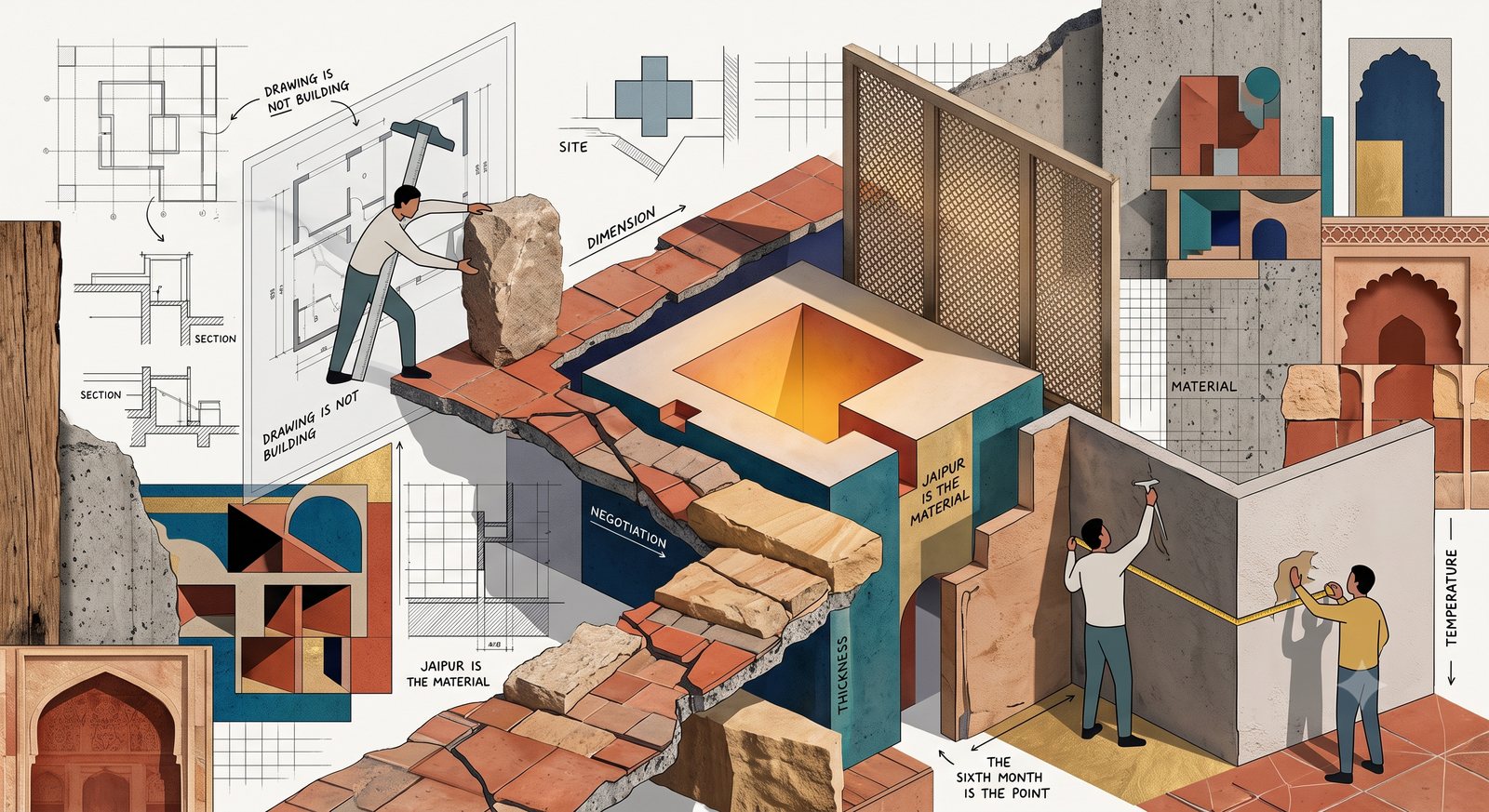
The drawing was correct. The site was not. A dimension that worked perfectly on paper had met a wall, a material that was supposed to be available was not, and the person who actually knew how the work would be built was standing beside the contractor. The detail had to change.
This is not an unusual moment on an Indian construction site, and it is one of the reasons I think an architecture student should spend part of their education here. Not because India offers an escape from the serious practice of architecture, and not because it is more authentic or more challenging than the student’s own country. It offers something more specific: a different distance between the architect, the drawing, the material, the contractor, the regulation and the person who finally builds the thing.
The internship that can look like a detour
If you are an architecture student already good enough to find an internship at home, India can look like an unnecessary deviation. You could spend those months inside a familiar professional system — the regulations, the construction culture, the language of the office — and continue along the path you have already started.
My answer is not that Indian practice will give you a superior version of architecture. It will give you a different set of problems. In a large, highly proceduralised practice, decisions are distributed across specialists: the drawing is issued, consultants coordinate, compliance is checked, the contractor builds. There is nothing wrong with that system, but a student can spend six months inside it without getting close to the negotiation that actually produces a building. In India that negotiation sits much closer to the architect.
There is a second thing, and it is the one I want to spend most of this article on. Not everyone who comes here is completing a requirement — some are, and some have finished their course and simply want to be somewhere else for a while. Either way, this is time nobody is forcing you to spend, and that changes what it has to be worth.
Where the drawing meets the site
The most important difference is what happens when a drawing meets the conditions of construction. A material is unavailable in the specified size and a local supplier proposes another solution. A contractor proposes a different sequence because the original one is impractical. A mason knows a way of making a detail that is absent from the drawing. A budget forces a change of material. In each case the architect has to respond, and the response is the design.
Cost stops being a number that appears at the end of a project and becomes a constraint on an ordinary working day. For a student, this exposes the decision surface of architecture: a drawing is not the building, but one instrument in a chain of negotiations.
I understand this personally. My own work has moved from luxury residential interiors into healthcare, and I am learning a new building type not by reading about it but by standing close to its requirements, its people and its construction decisions. The unfamiliarity is what makes the learning useful. That is what I would want a student here to experience — not an exotic version of architecture, but architecture with fewer layers between the decision and its consequence.
What the drawings never carried
Everything we were taught in college, we were taught from copies: plans, sections, photographs, occasionally a model. There is no real alternative, because buildings do not travel. They are the one thing in our discipline that cannot be brought into the room where it is being studied, so the discipline teaches the copy instead.
But the copy is edited, and always in the same direction. Thickness goes first — a wall in a photograph is a surface, whereas in a building it is a depth you pass through, and the passing takes time. Section goes next, and section is where most of the intelligence sits. Temperature goes, and with it the hour, so that a courtyard at eleven in the morning and the same courtyard at four in the afternoon collapse into one image when they are in fact two different rooms. What people did to the building afterwards goes as well, because in a published photograph alteration reads as untidiness rather than as evidence of where the original was generous enough to absorb change.
We are trained, in other words, on the flattering view.
Standing inside the building is not automatically the cure. You can walk through a courtyard house and come out with photographs of the courtyard — the thickness was there and went unregistered, the section was there and was never asked about. Presence supplies the evidence; it does not supply the reading. That is the part which cannot be arranged by buying a ticket.
India as a controlled comparison
This is where an internship in India can begin to look like tourism, and I would rather address that than pretend it is not a fair question. Jaipur is the answer to it, because Jaipur is not a base to leave from. It is the material.
It is a city that is very easy to photograph and quite difficult to read, usually presented as a set of facades — and facades are the part that survives reproduction best, which is why they are what people take home. What does not survive is here in unusual quantity: street proportions settled before there was any equipment to correct a mistake in them, so the dimensions themselves carry information; screen walls doing three jobs at once, admitting light, moving air and holding privacy, obvious within seconds in person and invisible in a photograph; courtyards behaving as thermal devices across the length of a day; buildings occupied and altered continuously, so the record of what worked is written into the fabric. Because all of this is ordinary here rather than exceptional, it can be looked at repeatedly, at different hours and in different months, until the reading gets better. That requires staying.
And you do not look at it alone. Ar. Rahul Saxena has taught architectural design at Aayojan School of Architecture, Jaipur, and reads these buildings with the students himself — the difference between a guided tour, where a building is explained to a group, and an argument on site with a practising architect who works in this region and will disagree with what you have just said. Why is this wall this thick is not a difficult question. It is simply not the question most of us think to ask while standing there.
Staying also puts other things within reach: pre-industrial cities worked out against heat and water, a planned imperial capital that was built and then not sustained, and the modernist canon at full size rather than in slides. But those are a consequence of being here for a while, not the reason for coming. The city you are in every day is the one you will end up able to read.
What this internship does not give you
Travel beyond the city costs money and comes out of your own time. The studio runs six days a week, so when you want to go far you take Friday and Saturday with Sunday and go properly — three days is what it takes to see something rather than photograph it, and a single day is a city trip nobody sustains every week.
You will not see everything, and you will sometimes be uncomfortable. The heat, particularly in May and June, is not an interesting story to tell afterwards; it is a condition you work in.
There is written work attached, and that is deliberate. Not a travel diary, but a record of what you looked at and what you concluded, in a form we agree with you. Without it, six months of looking becomes six months of remembering, which does not survive the flight home.
Some of what you learn here will not transfer to your own regulatory system. A construction method or approval procedure that makes sense in India may be irrelevant when you return. That is not a weakness; it is the point of comparison. You are not coming to replace your own professional context, but to understand another one well enough to recognise which parts of architecture are universal and which are produced by a particular system.
The sixth month is the point
You will take work home: studio projects, interiors, healthcare, community work, drawings you made and revised, sites you visited while they were being built, and photographs of some of them finished after you have left, because that is how construction works.
But the portfolio is not the part that changes what you do next. What changes is a different instinct in front of a drawing — you ask who will build it, what material is actually available, what the contractor will do when the detail meets the site, what a regulation means in practice rather than on paper. You look at an old city and see not a collection of monuments but a record of decisions made under particular conditions of heat, water and money. And you look at modernism differently, because you have stood inside buildings you previously knew only through photographs.
That is why I would not describe six months in India as a detour. I would describe it as a deliberate change in the conditions under which you learn architecture. You already know what your own system can teach you.
Come here to find out what it cannot.