Planning a LINAC facility: what each stage actually requires
The decision to add a LINAC radiotherapy facility is made in a boardroom. The outcome is determined by a sequence of regulatory submissions, construction tolerances, and team decisions most administrators meet for the first time.
In brief
- A LINAC facility moves through five AERB eLORA stages — Licence to Construct, Procure, Install, Commission and Operate — each a prerequisite for the next; realistic time to first patient is 20–36 months.
- The shielding design (by a medical physicist) sets wall thicknesses, which set room dimensions, which set the structure — so the physicist must be appointed before the architect draws.
- The AERB-approved drawing governs construction; deviations must be reported or re-approved, and honeycombing in a primary barrier wall is a radiation path, not a surface defect.
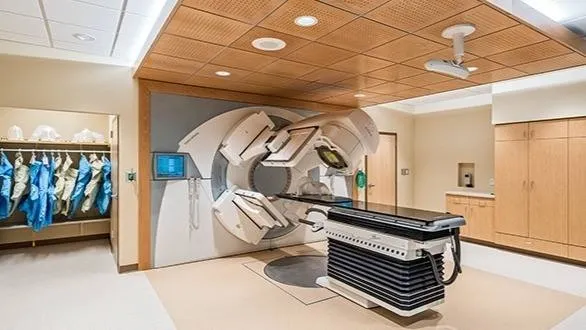
- The oncology department around the bunker is reviewed too — a good bunker in a poor department will not pass. Drawn from Jeevan Raksha Complete Cancer Care Centre, Bikaner.
The AERB eLORA licensing process for a new LINAC facility proceeds through five stages. Each is a prerequisite for the next. The total time from project initiation to first patient treatment runs to 20–36 months for a well-prepared team — and longer when any stage encounters documentation gaps, construction failures, or coordination breakdowns.
Studio Athenos, based in Jaipur, designed the radiotherapy facility at Jeevan Raksha Complete Cancer Care Centre, Bikaner — a 300-bed NABH oncology hospital with two LINAC bunkers, PET-CT and a gamma camera — navigating the process from Licence to Construct through to Licence to Operate. The stage-by-stage account below is drawn from that work.
Stage 1 — before construction: Licence to Construct
The AERB Licence to Construct cannot be applied for until the shielding design report and architectural drawings are complete. The shielding design — prepared by a qualified medical physicist — determines wall thicknesses, which determine room dimensions, which determine the structural system. The medical physicist must therefore be appointed before the architect begins drawing.
The LC application requires room layout drawings, a shielding design report, equipment specifications from the LINAC vendor, and structural drawings confirming load capacity. AERB will review the submission and may raise design queries — each requiring a formal written response with revised drawings. A complete, well-prepared first submission reduces the number of query cycles. Each cycle adds weeks; multiple cycles add months.
Lock your machine vendor and specifications before submitting the LC application. If the machine model changes after LC approval, the shielding calculations may need revision and the LC may require re-submission.
Stage 2 — construction: what cannot deviate
The AERB-approved drawing governs construction. Deviations must be formally reported — significant changes require re-submission and re-approval. The contractor must work only from the approved drawings, and the architect must be present during critical construction stages.
Primary barrier walls require staged concrete pours with designed vibration schedules. Honeycombing — internal voids caused by trapped air during pouring — is the most damaging construction failure in LINAC bunkers. In a standard wall it is a surface defect. In a shielded barrier it is a radiation path. Discovering it at the Licence to Install stage means the project stops for remediation. Prevention requires supervision discipline that most contractors have not applied to a hospital project before.
The oncology department surrounding the bunker matters as much as the bunker itself. AERB reviews the entire department — waiting area, changing room, control room, treatment planning room, mould room, CT simulator room. A well-designed bunker inside a poorly planned department will not pass review and will not function clinically.
Stage 3 — after construction: Licence to Install
The LI application requires as-built drawings confirming the structure matches the AERB-approved layout exactly, concrete density test records, and ventilation commissioning reports. The machine cannot be installed until LI is granted. Any structural defect discovered at this stage must be remediated before the application proceeds. Coordinate the LINAC delivery schedule with LI approval — the machine should not arrive on site before LI is granted.
Stage 4 — installation through to operation
After LI, the machine is installed and acceptance-tested by the medical physicist and vendor. The Licence to Commission application requires an acceptance testing report, radiation survey, and interlock verification. After LCom, the Licence to Operate application is possible. The LO is not the end of the regulatory relationship — it is the beginning of ongoing compliance. A dedicated Radiation Safety Officer, annual medical physics audits, and licence renewals are permanent obligations. Budget for them from day one.
Pre-design checklist
Before appointing your architect, confirm the following are in place.
- Medical physicist appointed with AERB credentials
- Machine model and energy configuration shortlisted
- Structural feasibility of proposed site confirmed
- Single internal point of contact for AERB correspondence identified
- Budget includes 15–20% contingency for regulatory delays
- Timeline expectation set at 20–36 months minimum
“We built our cancer care facility in Bikaner — LINAC bunker, PET scan, gamma camera — with Ar. Rahul of Studio Athenos. The difficult parts, the shielding and AERB requirements, were sorted at the drawing stage itself, so nothing held us up at commissioning. He understands how a cancer hospital runs, not just how to build one.”
Ar. Rahul Saxena, IGBC AP
Founding Editor · Studio Athenos, Jaipur
This article is part of Healthcare Design Dialogs, edited by Ar. Rahul Saxena, IGBC AP.